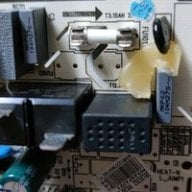
It's easier to solder.
Those capacitors are there to smooth out the powerline so leaving them there would be the best option.
Although under a ton of stress the cpu might get unstable, so far we haven't heard anyone complain about that yet though.
After installing the right transistors, I am still getting the same error. I decided to put the pics off and try to boot the switch without the pico. Now it’s not getting any power. I think I need to solve that problem first. Any suggestions where I should look maybe?
After installing the right transistors, I am still getting the same error. I decided to put the pics off and try to boot the switch without the pico. Now it’s not getting any power. I think I need to solve that problem first. Any suggestions where I should look maybe?
check to see if you damaged any of the pads and for accidental shorts (you can try plugging into pc to see if it detects in rcm and if it does then there is a bad pad/trace)
the points are already connected though unless the signal isnt strong enough otherwise?
check to see if you damaged any of the pads and for accidental shorts (you can try plugging into pc to see if it detects in rcm and if it does then there is a bad pad/trace)
It's easier to solder.
Those capacitors are there to smooth out the powerline so leaving them there would be the best option.
Although under a ton of stress the cpu might get unstable, so far we haven't heard anyone complain about that yet though.
That's good to know. When I removed the caps and powered on the switch (without pico) It wouldn't turn on. I had to re-solder the caps for it to power. Yet, it powers fine if soldered to the pico.
Would you please breakdown this for me? Pretty confusing.
Would you help me understand something? In the 2nd picture, you used the upper cap to get the D point. Does that mean, among all caps surrounding the APU, I could pick any for D-point? Or is it only the two caps we usually solder to the flex cable?
That's good to know. When I removed the caps and powered on the switch (without pico) It wouldn't turn on. I had to re-solder the caps for it to power. Yet, it powers fine if soldered to the pico.
Would you please breakdown this for me? Pretty confusing.
Post automatically merged:
That's a pretty smooth outer metal cut. Did you use any tools?
Post automatically merged:
Would you help me understand something? In the 2nd picture, you used the upper cap to get the D point. Does that mean, among all caps surrounding the APU, I could pick any for D-point? Or is it only the two caps we usually solder to the flex cable?
From what i've seen during these last 3-4years it's allways just the 2 caps used originaly on flex cables. Now with Pico I guess we can use just one of them (but still one of those 2).
You use the inner pads of caps for D point on V2 and the upper pads of caps on V1. The opposite pad of the caps in these situation corresponds to S point (basically Ground) so that means that you can also do something like this (see photo).
After welding the RP2040, the blue light on the chip turned blue and then flickered blue. The chip flickered for about a minute and I disconnected the power supply of the switch. I tried to restart the switch chip and the blue light flickered for about a minute. I disconnected the power and removed the RP2040. After removing RP2040, my switch cannot start.
I accidentally soldered emmc to rp2040 but forgot to remove the baterry. Now the switch I booted only shows a purple screen, is there a way to fix it? i have another machine that has mod hwfly can restore emmc error machine?
It’s about that time of year again where I check in with the community to see if we can get the front page aligned with what people are interested in knowing and what...
WiiCompiled is a new project that lets PC gamers play Mario Kart Wii natively on PC without emulation. Using static recompliation to convert the code into native PC...
Images for the rumoured Zelda-themed limited edition Switch 2 for The Legend of Zelda's 40th Anniversary have started to leak online.
The leak shows only the...
After being announced last year, the fan-made remake Gamma Emerald has finally gotten its first early access release. A complete rebuild of fan-favourite Pokemon...
The long awaited Grand Theft Auto VI Extended Look gameplay trailer has finally dropped on YouTube. As you all know, it had dropped 6 hours earlier on Netflix, and...
Though we knew all the way back in May that this was coming, the exact numbers remained a mystery for prospective Nintendo gamers in the UK. If you happen to have...
Thanks to the recent decomplication efforts; The Minish Cap 3DS brings the Game Boy Advance classic Zelda title to your 3DS.
The port takes full advantage of the 3DS...
In the wake of Sony's shift to a digital-only ecosystem within the next year, Xbox have today announced a surprising scheme. Aiming to offer physical buyers the same...
GBAtemp is and always has been an independent community. Since 2002 our staff have voluntarily kept the site running, added new forums, features, provided constant...
To celebrate its 25th anniversary, XBOX has launched pre-orders for the XBOX 25th Anniversary Collection. For the occasion, the trailer below was aired.
This...
It’s about that time of year again where I check in with the community to see if we can get the front page aligned with what people are interested in knowing and what...
After being announced last week, the first of two broadcasts is set to go live later today with a stark focus on The Legend of Zelda and its 40th anniversary...
Though we knew all the way back in May that this was coming, the exact numbers remained a mystery for prospective Nintendo gamers in the UK. If you happen to have...
In the wake of Sony's shift to a digital-only ecosystem within the next year, Xbox have today announced a surprising scheme. Aiming to offer physical buyers the same...
Images for the rumoured Zelda-themed limited edition Switch 2 for The Legend of Zelda's 40th Anniversary have started to leak online.
The leak shows only the...
The long awaited Grand Theft Auto VI Extended Look gameplay trailer has finally dropped on YouTube. As you all know, it had dropped 6 hours earlier on Netflix, and...
It is with a heavy heart that I announce the departure of our beloved Chary from the position of Chief Editor. Chary took over early 2021 and has done a wonderful job...
After being announced last year, the fan-made remake Gamma Emerald has finally gotten its first early access release. A complete rebuild of fan-favourite Pokemon...
Thanks to the recent decomplication efforts; The Minish Cap 3DS brings the Game Boy Advance classic Zelda title to your 3DS.
The port takes full advantage of the 3DS...
GBAtemp is and always has been an independent community. Since 2002 our staff have voluntarily kept the site running, added new forums, features, provided constant...