
NAND LUN Sectors

  • Thread starter Thread starter slimeinacloak
  • Start date Start date
  • Views Views 1,036
  • Replies Replies 5
  • Likes Likes 10

slimeinacloak

Well-Known Member
Newcomer
Joined
Dec 1, 2024
Messages
90
Reaction score
162
Trophies
0
XP
512
Country
Australia
If anyone is curious yes the JCID U15 can be used to dump the nand of a switch 2,

Info from my console (day 0 firmware (i hadnt even turned on the console lol)):
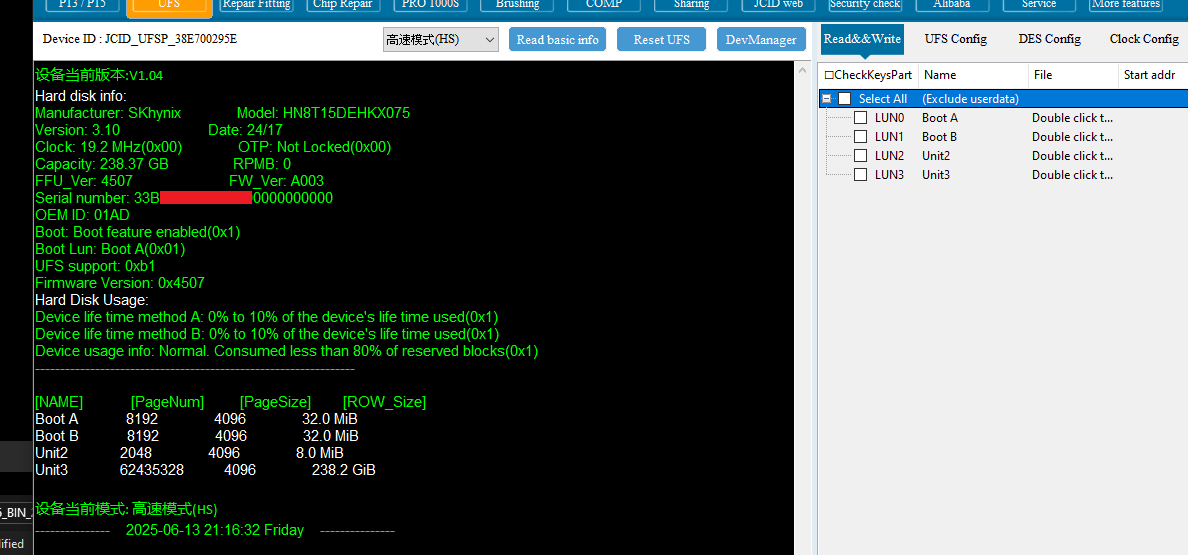
device info.PNG


If someone who seems like they would have a valid reason to take a look at the dump send me a message (I dont want to just post it online for anyone to see lol)
Also yes all the LUN partitions are encrypted and don't look like the ones from a switch 1.

The 238GiB partition compresses to 561MB as its just all 0s past the first bit.

ik its a bit pointless to do this as there is no way to get the console keys (yet) to decrypt it but 🤷‍♀️

(side note, the nand seemed to take less heat to get off than the ones on the oled so maybe different solder idk)
 
Last edited by slimeinacloak,
If anyone is curious yes the JCID U15 can be used to dump the nand of a switch 2,

Info from my console (day 0 firmware (i hadnt even turned on the console lol)):
View attachment 510962


If someone who seems like they would have a valid reason to take a look at the dump send me a message (I dont want to just post it online for anyone to see lol)
Also yes all the LUN partitions are encrypted and don't look like the ones from a switch 1.

The 238GiB partition compresses to 561MB as its just all 0s past the first bit.

ik its a bit pointless to do this as there is no way to get the console keys (yet) to decrypt it but 🤷‍♀️

(side note, the nand seemed to take less heat to get off than the ones on the oled so maybe different solder idk)
If I had to guess I'd say the two boot partitions are the same as the Switch 1 and the prodinfo resides in the third partition with the rest of the system contained in the large partition. Like you said though, can't do much without keys.
 
The partition layout is different to how an andriod layout is, I cant say much more than that, looking at the lun3 it doesnt look like gpt to me and running a partition search didnt show anything.

Example of how an andriod nand shows:
 
Hmm Boot A and Boot B really reminds me of Android. I wonder if you could "force it" to Boot B. Thats how Pixels do incase one of them breaks, you can restore the other partition.
 
LUN0 and LUN1 (BootA/B) are identical so it would make sense its similar to android using BootB as a backup. I might have a look at a dump of an android nand to see what that looks like in comparison
 
  • Like
Reactions: falcorr
Hmm Boot A and Boot B really reminds me of Android. I wonder if you could "force it" to Boot B. Thats how Pixels do incase one of them breaks, you can restore the other partition.
LUN0 and LUN1 (BootA/B) are identical so it would make sense its similar to android using BootB as a backup.
It's not really the same thing (it could be used for that purpose, sure, but it's not needed - even the 3DS has A/B kernel partitions), these "partitions" are walled off at the controller level like NVME namespaces (another feature that, if taken advantage of, will probably utterly confuse most cheap and/or USB implementations),
intended for the first stage bootloader after the bootrom (the intention being, it's relatively hard to access NAND memory especially from a plurality of manufacturers so let's standardize as much as possible how to access some critical sectors)
and, most importantly, are often totally ignored by OEMs because nowadays the benefits are not worth the inconveniences!

http://hub.mender.io/t/guidelines-for-using-the-emmc-boot-partitions/2220/3
http://forum.beagleboard.org/t/a-emmc-partitions-convention/32309/
(sorry, discourse browser-discriminating crap, but the important things to know are there)
 
  • Like
Reactions: linuxares

Site & Scene News

Popular threads in this forum