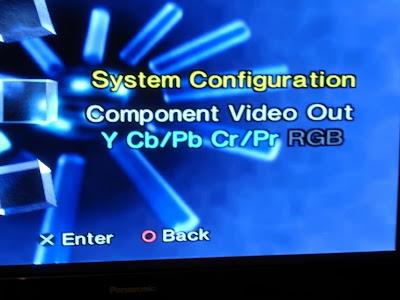
Not enough pins for a complete image. Component uses 3 pins, standard RGB needs at minimum 4 (red/green/blue/sync).
Not exactly. Sync pulses happen between the lines of the image, so they can be mixed onto any channel losslessly. Component and S-Video mix it on Y, on RGB you can mix it onto the green channel. SCART does not do so, though, it uses the dedicated composite line to carry the sync pulses, often as part of a complete composite signal.
Fun fact: to save money, on cheap TVs if there were, say, 3 SCART inputs, only 1 of them would have the full pinout with RGB+Composite+Audio, whereas the others would only support Composite+Audio. That's probably why Sony kept including the Composite-to-SCART cable instead of a RGB-over-SCART, to have 100% compatibility with any SCART port and tv set.
Actually, you can feed composite and RGB simultaneously, so that is not the reason. The actual reason is that RGB takes 3 more wires (6 if you want a dedicated return path for each, which is standard for SCART), so wiring just composite is cheaper. Interestingly, I had once used a sony television that had two SCART ports, labeled "AV1/RGB" and "AV2/YC2", with an additional "AV3/YC3" available at the front made up of composite, S-Video and audio. The YC2 port actually accepted S-Video signals over the RGB lines, transmitting Y over composite and C over red.
One interesting feature of SCART is its bidirectionality. Back in the day, you could connect a television to a VCR using SCART and use a single tuner for both to record what you are watching. The composite and audio lines are duplicated on the connector, with one line going from the television to the VCR and one line going back. Since analog television was broadcast as a composite signal anyway, you did not need the full RGB set to feed into the VCR, you could use composite without loss of quality, whereas direct-to-cassette productions could use the full RGB quality to go straight from the tape to the screen.
Secondly, back then, we also got 60 Hz refresh rate versus 50 Hz that Europe got, so each region had the superiority to the other when it comes to picture.
The 60 Hz was balanced by the higher resolution we could fit into a single picture, though. The broadcast systems commonly used in Europe, which by the way have little to do with the color encodings PAL/SECAM/NTSC other than geographical correlations, namely B, C, D, G, H, I, K and L, as well as the overseas K' and N, all support 625 instead of 525 lines, resulting in 576 instead of 480 visible lines while still having more time for a single line than NTSC formats, resulting in finer details to be visible with the same bandwidth. Of course, that was back in the day where slowly-refreshing screens tended to flicker a lot, so the American system M with its 60 Hz had a clear advantage there - though that was due to the higher mains frequency over there.
As for why we didn't use RGB, beats me. TVs use RGB internally, so to use composite they have to separate out the different color signals first. A technically inclined person could feed an RGB signal to their display, but you're not gonna find any standard cables for the average consumer to do it.
The advantage of Y/C over RGB is that you only need two lines instead of three. And even with component, the two color signals can be of lower quality than the Y signal, because the human eye resolves brightness more finely than color. Which is why pretty much every storage and broadcast format uses YUV or a variation.
Nowadays, though, everyone's using Component or HDMI HD signals, and Europe now has their PAL 60 to match our refresh rate, so we're pretty much on even footing.
60 Hz PAL is not even European. It was originally set up for Brazil, which has 60 Hz mains power and therefore used system M for black-and-white television, but unlike every other M country adopted PAL instead of NTSC. PAL60 is not exactly that though, according to Wikipedia it uses the same color carrier as PAL-BDGKI, instead of PAL-M which uses the same one as NTSC-M. It is just some weird hybrid that some manufacturers came up with to slightly widen the range of televisions that could be fed a signal of 60 Hz field rate. Most televisions that eat PAL60 should also take PAL-M and NTSC-M, though, so there is little gain there.






 , but the fact of the matter is an RGB cable can only output at a maximum of 480i, thus, for anything recent a vga or component is obviously a better choice, but for retro consoles the picture is superior to s-video. Basically here in Europe an RGB cable for anything up to the N64 is a fine purchase (and vga aside also a good buy for the PS2 & GC - PAL GCs didn't have 480p support)

 You're welcome.