A super computer for everyone!

  • Thread starter Thread starter Tom
  • Start date Start date
  • Views Views 6,976
  • Replies Replies 41

Tom

Gbatemp's Unofficial Modder
Member
Joined
Feb 9, 2009
Messages
987
Reaction score
115
Trophies
1
Age
30
Location
New jersey
XP
516
Country
United States
I stole most of this article from hackaday FYI

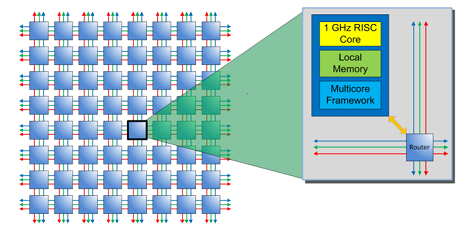
Even though dual, quad, and octo-core CPUs have been around for a while, it’s a far cry from truly massive parallel computing platforms. The chip manufacturer Adapteva is looking to put dozens of CPUs in a small package with their Parallella project. As a bonus, they’re looking for funding on Kickstarter, and plan to open source their 16 and 64-core CPUs after funding is complete.

With any luck, the Parallella multicore computer will be available for $99, much less than a comparable x86 multicore computer. It’ll certainly be interesting to see what the Parallella can do in the future.
(I Did the rest of this article myself)

f655b21138f173cf2c6dc2d3cff7c8f6_large.png


Some AMAZING specs:
  • Dual-core ARM A9 CPU
  • Epiphany Multicore Accelerator (16 or 64 cores)
  • 1GB RAM
  • MicroSD Card
  • USB 2.0 (two)
  • Two general purpose expansion connectors
  • Ethernet 10/100/1000
  • HDMI connection
  • Ships with Ubuntu OS
  • Ships with free open source Epiphany development tools that include C compiler, multicore debugger, Eclipse IDE, OpenCL SDK/compiler, and run time libraries.
  • Dimensions are 3.4'' x 2.1''
  • 45GHz Not a typo you read me 45GHz!!
  • $99
Once completed, the Parallella computer should deliver up to 45 GHz of equivalent CPU performance on a board the size of a credit card while consuming only 5 Watts under typical work loads. Counting GHz, this is more horsepower than a high end server costing thousands of dollars and consuming 400W.

cores.png


Kick starter link! http://www.kickstarter.com/projects/adapteva/parallella-a-supercomputer-for-everyone?ref=live

C'mon With the help of the Temp we can help them reach that goal.

 
Having a potential of 45Ghz is only relevant if all the cores get utilized fully. How many programs nowadays fully use more than 2-3 cores at any given time? If there are 64 cores, and programs used only 2 cores at any given time, you'd fully utilize the hardware if you had 32 separate programs running. How many people run that many programs at any given time?
 
Counting GHz, this is more horsepower than a high end server costing thousands of dollars and consuming 400W.
Uh. There's a problem. GHz is not actually a measurement of speed.
that is a quote from the manufacturer, but you have to admit 16-64 cores is awesome, the localized memory for each processor would also increase speed
 
I can see many uses for this technology.
Next generation of protable hand-held gaming devices?
The basis for the next iteration of the K101 Revo with enhanced emulation?

Actually, I am not overly impressed with the specs of a dual-core ARM9 for the processor.
How exactly is this functionally different than a current PC utilizing Nvidia's CUDA technology for multi-core acceleration of processing tasks? (Think Nvidia FERMI chipset.)

BOINC has been using this concept to use ATI and Nvidia multicore video cards to assist and accelerate processing in distributed computing projects for some time now.

Speaking on distributed processing, why let your unused processing cycles go to waste when you are not using your computer?
Donate them to a worthwhile project of your choice that will use them for scientic research. Google BOINC and check out what is available.
 
I can see many uses for this technology.
Next generation of protable hand-held gaming devices?
The basis for the next iteration of the K101 Revo with enhanced emulation?

Actually, I am not overly impressed with the specs of a dual-core ARM9 for the processor.
How exactly is this functionally different than a current PC utilizing Nvidia's CUDA technology for multi-core acceleration of processing tasks? (Think Nvidia FERMI chipset.)

BOINC has been using this concept to use ATI and Nvidia multicore video cards to assist and accelerate processing in distributed computing projects for some time now.

Speaking on distributed processing, why let your unused processing cycles go to waste when you are not using your computer?
Donate them to a worthwhile project of your choice that will use them for scientic research. Google BOINC and check out what is available.
dual core a9 then 16 other epiphany cores
 
With this technology, you could probably build a tablet or laptop with Thrice the specs of any $500 PC build, for a fraction of the cost... Well, maybe.
 
With this technology, you could probably build a tablet or laptop with Thrice the specs of any $500 PC build, for a fraction of the cost... Well, maybe.
I was thinking of putting it in my old laptop casing :)
 
Having a potential of 45Ghz is only relevant if all the cores get utilized fully. How many programs nowadays fully use more than 2-3 cores at any given time? If there are 64 cores, and programs used only 2 cores at any given time, you'd fully utilize the hardware if you had 32 separate programs running. How many people run that many programs at any given time?

I find that over time one tends to find was to utilize available computer resources. Increased stability and interconnectivity allows one to have many more programs running in the background utilizing the capabilities of your system to benefit you. Having email, fax, weather gadgets, real time monitoring and trend tracking analysis all use resources. The advent of more 64 bit software allows on to access a much greater memory map than the older 32 bit software.

These are great times to have a personal system. We have come a long ways in the last few years.
 

Site & Scene News

Popular threads in this forum