


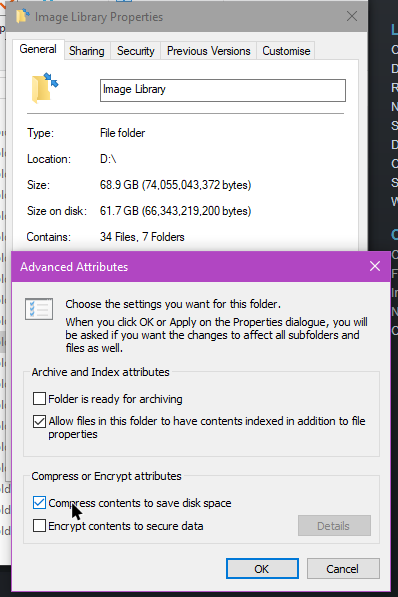
I got a 2TB external HDD and was wondering which file system and cluster size would be the best for it as I have no plans of reformatting ever. (All the info I found on Google was old and/or conflicting.) Also, would the recommendation change if I threw encryption into the mix? Thanks in advance!








Similar threads


Site & Scene News
New Hot Discussed
-
-
11K views
ROM Hack Ocarina of Time 3D gets huge mod to enable single-screen play
Ocarina of Time is back in style as the upcoming Switch 2 remake looms on the horizon. But what's a fan of the game to do over the next few months? If you've been... -
8K views
Pokemon Yellow added to first generation recompilation library, voxel mod updated to support "3Dish battles"
It's a good time to be a first generation Pokemon fan. But when was it not a good time to be one? In recent weeks we've seen a native LOVE2D recreation of Pokemon Red... -
8K views
ROM Hack Better Super Mario Sunshine Online released, adds online co-op and custom hide and seek game mode to play
If you've been waiting for an excuse to replay Super Mario Sunshine and happen to have up to nine friends, do I have some good news for you. Released earlier today... -
7K views
ROM Hack Pokemon Timeless Diamond and Spaceless Pearl released, enhances original Sinnoh releases with quality of life changes and new events
For fans of Sinnoh, the pickings are slim. If you want the best experience you're left deciding between the updated region in Platinum, or the somewhat controversial... -
6K views
ROM Hack Pokemon Emerald EX released, features new routes and towns alongside eight new gyms
Hoenn to the ROM hacking scene is like Kanto to the official games. It's everywhere. At this point you've probably played through Pokemon Emerald with a party of... -
6K views
Homebrew app Wii U emulator Cemu gets a homebrew Switch port, Wind Waker HD shown running at full speed
Hot on the heels of their NetherSX2 port, @Nagaa is back with another hugely anticipated release: a Switch port of the popular Wii U emulator Cemu. We've got more... -
6K views
Limited Edition Zelda-themed Switch 2 images have leaked online
Images for the rumoured Zelda-themed limited edition Switch 2 for The Legend of Zelda's 40th Anniversary have started to leak online. The leak shows only the... -
6K views
Homebrew app GameCube and Wii emulator Dolphin gets a native Switch port, supports RetroAchievements and loading from USB storage
The golden age of emulation on the Switch continues as a native Dolphin port was released by @Nagaa earlier today. Included in this port, we're looking at cover art... -
5K views
ROM Hack Pokemblem is the best spin off Game Freak never made
The Pokemon series is known for its vast assortment of spin off titles, with the majority being well-received. We've had an assortment of Mystery Dungeon titles, a... -
5K views
Nintendo Direct announced for the 4th of August, set to feature 20 minutes of the new Fire Emblem game
With the latest entry to the Fire Emblem series, Fortune's Weave, set to launch in September, Nintendo have today announced a new Nintendo Direct to put it soundly in...
-
-
-
89 replies
Limited Edition Zelda-themed Switch 2 images have leaked online
Images for the rumoured Zelda-themed limited edition Switch 2 for The Legend of Zelda's 40th Anniversary have started to leak online. The leak shows only the... -
68 replies
ROM Hack Ocarina of Time 3D gets huge mod to enable single-screen play
Ocarina of Time is back in style as the upcoming Switch 2 remake looms on the horizon. But what's a fan of the game to do over the next few months? If you've been... -
62 replies
Nintendo Direct announced for the 4th of August, set to feature 20 minutes of the new Fire Emblem game
With the latest entry to the Fire Emblem series, Fortune's Weave, set to launch in September, Nintendo have today announced a new Nintendo Direct to put it soundly in... -
49 replies
Pokemon Yellow added to first generation recompilation library, voxel mod updated to support "3Dish battles"
It's a good time to be a first generation Pokemon fan. But when was it not a good time to be one? In recent weeks we've seen a native LOVE2D recreation of Pokemon Red... -
48 replies
Unreal Engine 5 fan remake Gamma Emerald gets its first early access release
After being announced last year, the fan-made remake Gamma Emerald has finally gotten its first early access release. A complete rebuild of fan-favourite Pokemon... -
40 replies
Everyone thinks The Elder Scrolls VI will be called Sentinel
Over the past week, rumors have started swirling as Redditors (probably correctly) deduced the title of the upcoming Elder Scrolls game, which will apparently be... -
37 replies
It’s decent enough - an early look at Oblivion Remastered on Switch 2
So I got pretty lucky on this one. Having ordered the physical version of Oblivion Remastered on Switch 2, I had it delivered earlier today, beating out the official... -
37 replies
Remasters for Fallout 3 and New Vegas announced, Fallout 5 still in development
Amidst news of layoffs and cancellations in the wake of Xbox's larger changes, Bethesda has today come out with a statement discussing their active projects. In this... -
36 replies
ROM Hack Pokemon Timeless Diamond and Spaceless Pearl released, enhances original Sinnoh releases with quality of life changes and new events
For fans of Sinnoh, the pickings are slim. If you want the best experience you're left deciding between the updated region in Platinum, or the somewhat controversial... -
28 replies
ROM Hack Pokemon Emerald EX released, features new routes and towns alongside eight new gyms
Hoenn to the ROM hacking scene is like Kanto to the official games. It's everywhere. At this point you've probably played through Pokemon Emerald with a party of...
-


