SuperChis Prime: How I Fixed the SuperCard SD's Flaws on a Budget

Hello players, I'm one of the designers behind the SuperChis project. I’d like to share, from an engineer’s perspective, the thinking and execution behind our new GBA flash cartridge, the SuperChis Prime.

Our goal was clear: to create a genuinely "good" budget cartridge within a $15~$25(depends on tax and shipping) price range by solving the core issues that plague the classic SuperCard SD.
This wasn't just about patching an old design; It's a reconfiguration for a better future.
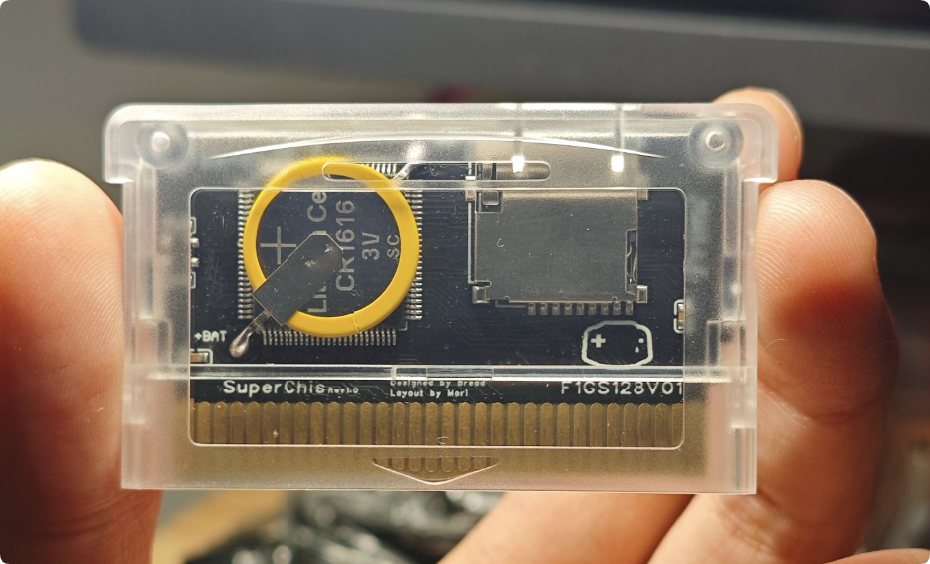
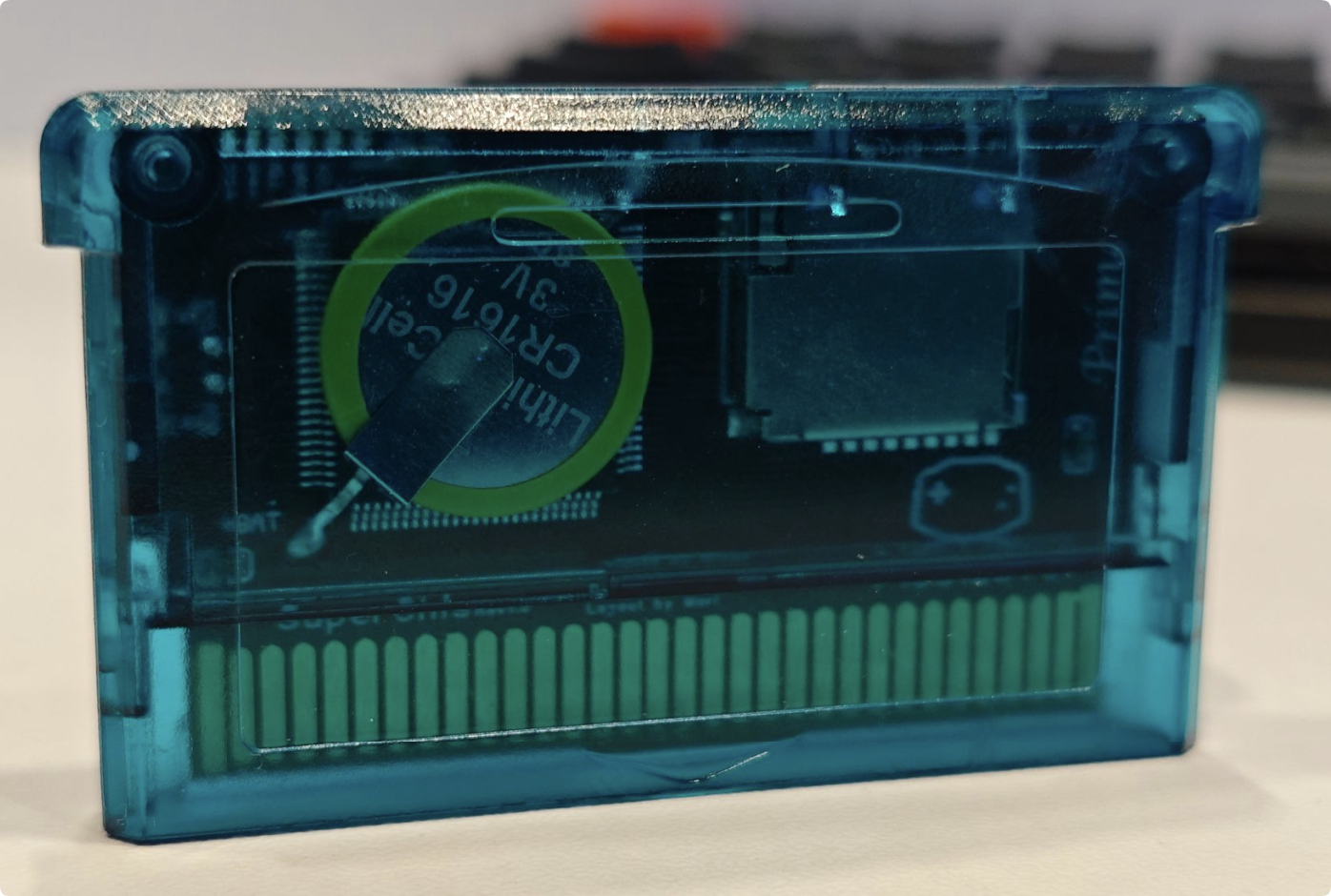
1768192599542.png
1768192570785.png

1. Hardware: Targeted Solutions​

The root causes of the classic SuperCard's problems—"slowdown" and "white screens"—lie in its SDRAM timing compatibility and the need for "slowdown patches" for every game. Our approach was twofold:

  1. Using Large NOR Flash to Bypass SDRAM Issues: I replaced the NOR Flash with a larger-capacity chip. When a game is written to the Flash, the GBA CPU reads directly from it, completely bypassing the problematic SDRAM access timings. This eliminates "slowdown" and the "white screen/freeze" caused by failed patches at a fundamental level. We also deeply optimized the write speed. Burning a 32MB game takes about 105 seconds on the standard version, and only about 85 seconds on the "Micron" version with higher-performance Flash.
  2. Premium PCB Process: To ensure long-term reliability, especially for the contact fingers, we use a 2U Immersion Gold (ENIG) process for our PCB manufacturing. It's an invisible upgrade, but we believe it's essential.
  3. Standardized and elegant PCB layout: It can improve product stability and avoid some anomalies that are not caused by component quality. Thanks to Mori, for his perfectionism.

2. CPLD Firemware: A Clean-Slate Approach for a Better Future​

The original SuperCard's CPLD firmware was "black box". So, we made a decision: we started from scratch with a completely new, forward-designed firmware. Thanks to davidgf for the many suggestions, which have benefited me a lot.

  • More Developer-Friendly: The new firmware has clear logic, avoiding potential register conflicts and other hidden issues. This provides a much better foundation for long-term support and feature development for excellent third-party kernels like SuperFW.
  • Multiple compatibility interfaces: We are compatible with SuperCard SD's SD Write/Read, and also support SuperCard Lite's SD Read. This helps to quickly migrate existing excellent software.

3. "Hybrid Architecture" and Fragmented Flash Management​

Making a simple NOR Flash cart isn't hard. The challenge was balancing flexibility and features at a low cost.

  • Fragmented Flash Management: Users don't need to worry about a game's physical location on the Flash. You can add or delete games as easily as managing files on your phone, and the system handles the space allocation automatically.
  • Retaining SDRAM for Unique Value: We didn't discard the SDRAM just because we added Flash. We repurposed the SDRAM as a "preview/launch area" and, crucially, as the memory for some feature. This "Flash + SDRAM" hybrid architecture allows us, at a low cost, to offer both "instant game launch with no slowdown" (from Flash) and "advanced features like Instant Saves" (from SDRAM).

4. GBA Firmware​

At present, SuperFW has fully supported SuperChis and may be released in next version. Because SuperChis are forward compatible, there will be more custom firmware support in the future. It's worth noting that the time to enter the SuperFW was reduced from 6 seconds to 1 second because we had a larger Flash and avoided asset decompression. davidgf's rotating meta data design largely avoids uneven flash writes.

5. The Necessary Trade-Offs​

Within our strict cost targets, we had to make some compromises:

  1. No RTC/Rumble/... Support: This was to control core chip complexity and cost. The software clock in the SuperFW kernel keeps time while in-game.
  2. Standard Battery-Backed Save: The standard version uses a CR1616 battery with low-power SRAM, offering a theoretical save retention of up to 20+ years (conservatively estimated at 10). We solved the problem of SuperCard batteries dying prematurely by using low-power SRAM and designing strictly according to the manual.
  3. Compatibility issues: We have found that the some GBAs on the motherboards labeled 02 have power supply issues, and cannot use the common NOR Flash, and need to use the more expensive low-power, high-performance NOR Flash, for which I have already funded research, and hope that the 02 motherboards can be resolved in the future with a simple mod. Or you can replace it yourself with a more expensive flash like the MT28.
  4. Save Game Handling: Support for games with EEPROM/Flash saves relies on the SuperFW database and patching engine. While this covers virtually all commercial games, some homebrew titles (e.g., certain Pokémon ROM hacks) may require manual intervention.
  5. Use recycled ICs: Whether it is mass production or DIY, for GBA game scenarios I recommend using tested recycled ICs. Especially for those NOR Flash that still have more than half of their life left. This is more economical and environmentally friendly. Of course, the test process includes full erasure, writing, stress testing, etc. Of course, you can also replace it with a new NOR Flash by yourself, which will cost $20~$30. As long as the speed is faster than S29GL01GS12, it will be a good Flash choice.

6. Acknowledgments and Planning​

Thanks to Mori, and Davidgf for supporting this project. More versions of the SuperChis series will be released in the future, and the core ideas will be open-sourced to encourage more interesting innovations. The CPLD implementation of the original SuperCard can be found at SuperChis.
 
Hello , slowdown on game like supermario advance 2 ( super mario world ) are confirmed? i don't really understand FRAM and SRAM version , which one is better?
thanks for your job ;)
The difference lies in how the cartridge handles saving. FRAM is non-volatile memory, meaning the save file is retained permanently. SRAM, on the other hand, is volatile memory and requires a battery to preserve the save data. SRAM is also a cheaper chip compared to FRAM.
 
thanks for the answer , and what about slowdown ? , i got an old supercard , SUPERFW is really the St graal but slowdown in game like Super Mario Advance 2 , perhaps i miss something to bypass this , it's so old in my mind. GBA is really a good machine and i love it ^^
 
Yo, is anyone else having problems with it on DS's running flashme firm?

It runs fine fine on my standard DS lite, but wont boot on my other 2 with flashme installed.

EDIT: Nvm i was being an idiot, turns out superfw supports ds mode on flashme devices, so it doubles as a ds flashcard it seems, and i can just hold SEL at startup to boot into gba mode, pretty cool. Might buy a second one for this alone.
 
Last edited by fantasma_do_cu_cagado,
I have encountered a strange issue with my SuperChis cartridge and I'm trying to understand if it can be recovered.

Initially everything worked fine. I installed firmware 0.20, and the cartridge booted normally.

However later something unusual happened. The cartridge suddenly stopped booting:

  • On original hardware (GBA) it freezes on the Nintendo logo screen during boot.
  • On Analogue Pocket it shows “Bad Header”.
The only unusual thing I did before this happened was testing different microSD cards with the cartridge. One of the cards I inserted was a 512 GB card formatted in ext4 (it previously came from a Steam Deck). I forgot that it was not FAT/exFAT formatted. After inserting this card the cartridge stopped booting completely.

My assumption is that something in the cartridge firmware might have been corrupted.

With the original SuperCard, there are many Nintendo DS homebrew tools that can reflash or recover the cartridge firmware if it becomes corrupted.

So my question is:

Are there any similar recovery tools for SuperChis?
For example DS homebrew utilities or any other method to reflash or restore the cartridge firmware?

Or is the only recovery method using a hardware flasher / programmer?

Any advice would be appreciated.


UPD: I managed to recover the cartridge.

It turns out the cartridge can be reflashed using the Superfw-nds-flasher-tool. I ran the tool from a Nintendo DS and successfully reflashed the firmware.

The cartridge is now working normally again.

Huge thanks to ChisBread and DavidGF — absolute geniuses.
 

Attachments

  • 20260305_145724.jpeg
    20260305_145724.jpeg
    4.1 KB · Views: 18
  • IMG_5238.jpeg
    IMG_5238.jpeg
    66.4 KB · Views: 21
Last edited by ak1nok,
  • Like
Reactions: FirroGamer
Are there any similar recovery tools for SuperChis?
For example DS homebrew utilities or any other method to reflash or restore the cartridge firmware?
You can use the normal SuperFW recovery tools for DS. They support the Superchis for a few weeks.
 
  • Like
Reactions: ak1nok
Hello there, I‘m new here

I bought a SuperChis Prime on Aliexpress (https://a.aliexpress.com/_EIHfPE4) but I‘m not sure, if it is really a superchis

For me, it seems like a SuperCard
 

Attachments

  • IMG_7389.jpeg
    IMG_7389.jpeg
    2.9 MB · Views: 31
  • IMG_7390.jpeg
    IMG_7390.jpeg
    2.8 MB · Views: 24
  • IMG_7388.jpeg
    IMG_7388.jpeg
    2.4 MB · Views: 19
  • IMG_7387.jpeg
    IMG_7387.jpeg
    2.3 MB · Views: 22
Last edited by DarkVoidOwner,
Evri such wankers. it's an absolute joke.
Evri is just as bad as Royal Mail.

"Packages lost? It's not our problem." - what a joke

Hello there, I‘m new here

I bought a SuperChis Prime on Aliexpress (https://a.aliexpress.com/_EIHfPE4) but I‘m not sure, if it is really a superchis

For me, it seems like a SuperCard
Send it back to the seller, you got scammed. This is 100 percent a SuperCard SD clone and not the Prime model.
 
Ironically I've been using the SuperChis more as a DS flashcart on my DS Lite. SuperChis support was added to pico-loader but you have to use the one built by Github actions because it's not in the latest stable build. It's pretty convenient being able to run in both native DS and GBA mode depending on how you boot it. It's become my main cart because of this actually. Decent GBA cart. Actually pretty good DS flashcart.
 
  • Like
Reactions: metroid maniac
Hello i've received mine ^^
Just to confirm it's a really great cart ^^ after flashing game to flash memory it's wonderfull , Super Mario Advance 2 run like the real card ;) ;)
Perhaps SuperFW can add better way to flash it directly in menu before launch , press Select can be miss ^^
But i love this cart thanks
 
Heya! just made an account for this, but i recently got my Superchris Prime off aliexpress and i was enjoying metroid fusion, having a blast, when i remembered about the tiny chao garden, so i got sonic advance + sonic pinball party, booted up pinball party, went straight to the tiny chao garden, and imported a chao from my sa2 copy, saved and exited because i had to go to work, and when i finished my shift, i open the tiny chao garden again to find... nothing but a blank egg, my chao no where to be found... any help with how to get sa1/pinball to save chao garden data would be greatly apprieciated!! :>
Post automatically merged:

So update: i used a save with a tails chao to transfer to sa2, and when i did, i saved & exited, and it froze for 30 seconds, before i went to the tiny chao garden again, and saw a blank egg like i have had for a while
 
Last edited by Joeblueblur9,
  • Like
Reactions: Flame
Hi everyone! ,anyone has superchis Fram, plz test super mario Advance 4, is it save correct or not because when I save the game then I load it again ,it won't hold the save at all and start from the beginning.
 

Site & Scene News

Popular threads in this forum