

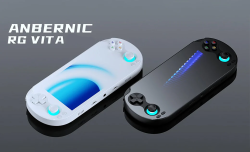
 Anbernic RG Vita GBAtemp review
Hardware
Product Information:
- Official Store: https://anbernic.com/
I spent about a week using the Anbernic RG Vita as my primary handheld. That meant quick retro sessions during the day, longer gaming sessions at night, testing Android apps, experimenting with emulation, and even streaming games from my PlayStation 5. By the end of that time the device had a very clear identity.
The RG Vita looks like a PlayStation Vita and the name strongly suggests that it might act as a modern Vita replacement. In practice it behaves much more like a comfortable Android handheld that excels at PSP, performs well with Dreamcast and older systems, and offers a lot of flexibility thanks to Android. Once I stopped thinking of it as a “Vita successor” and started thinking of it as an “RG PSP,” everything clicked.


Technical Specifications
The device I'm reviewing is the base RG Vita model, however Anbernic has also announced the Pro model with specs that as of the time of this review have not been announced.
- Display: 5.46 inch IPS touchscreen
- Resolution: 1280 × 720
- Aspect ratio: 16:9
- Processor: Unisoc T618
- RAM: 3GB
- Internal storage: 64GB
- Expandable storage: microSD card
- Battery: 5000mAh
- Operating system: Android 12
- Connectivity: WiFi and Bluetooth
- Controls: dual analog sticks, D-pad, triggers, shoulder buttons, face buttons
- Other features: vibration support
Setup and first impressions
The first setup process is extremely fast. From powering the device on to finishing the Android configuration took roughly two to three minutes.
Many enthusiasts eventually replace stock firmware on Anbernic devices with custom operating systems like GammaOS. At the time of writing GammaOS is not yet available for the RG Vita. Because of that I decided to use the device exactly as it comes out of the box.
The stock firmware works perfectly fine, though like most Android devices it can be customized if you want a more polished experience. One advantage of running Android is that the device can connect directly to the internet. This means you can install files and apps directly on the handheld like you could with any Android phone.
And while we’re on the subject of downloading content, this device comes with a microSD card included. It’s no secret that Anbernic microSD cards are not always the most reliable. Because of that I highly recommend you use your own microSD card from a reputable brand. Even in today’s market, they are relatively inexpensive and tend to be far more reliable than the card that comes with the device. On that same note, I would also recommend not paying extra for larger capacity cards from Anbernic directly. It is usually cheaper and safer to buy your own card.
That said, for someone who wants a simple plug-and-play experience and doesn’t want to deal with buying anything else, the included card may still be sufficient and that’s what I used when testing the device.
Build quality and controls
As the name implies, the RG Vita clearly takes inspiration from Sony’s PlayStation Vita. The overall silhouette, the large center screen, and the dual analog sticks are unmistakably similar.
Fortunately this is not just cosmetic. The design is genuinely comfortable. The grips allow your hands to rest naturally and the device feels good during longer play sessions. Even after extended use my hands never cramped the way they sometimes do with smaller handhelds.
The plastic shell feels solid and well assembled. It doesn’t feel like a premium console device, but it also doesn’t feel fragile or cheap. One small issue I noticed is that the display can show glare in bright lighting conditions. Indoors this is rarely a problem, but strong overhead lighting or sunlight can produce reflections.
The controls meanwhile well suited for the systems the RG Vita runs best. The analog sticks feel smooth and responsive. They worked well for both emulation and streaming (I’ll get to that a little later), and PSP games in particular benefit from having two analog sticks available.
The face buttons feel responsive with a firm press. The D-pad is reliable for retro gaming and menu navigation. Triggers and shoulder buttons are easy to reach and comfortable for extended play sessions. Overall, I don’t really have much to complain about when it comes to the controls here.
Display
The display is one of the highlights of the device. The 5.46 inch IPS panel with a 1280×720 resolution looks sharp at this size. The 16:9 aspect ratio is perfect for PSP games and works well for Android apps and streaming. Colors look vibrant and menus are easy to read.
However it is worth noting that while the screen works well for gaming, it is not going to match the quality of a modern high-end smartphone display. Watching YouTube or streaming video through services like Netflix works perfectly fine, but the experience is noticeably lower quality than watching the same content on a flagship phone with a higher resolution display and more advanced panel technology.
The display can also show glare in bright lighting environments, which may require adjusting the viewing angle when playing outdoors.
Emulation performance
Alright, alright. I know this is what you really care about. The Unisoc T618 processor is well known in the retro handheld community. It provides excellent performance for older systems and reasonable performance for some more demanding consoles.
Retro through PlayStation 1:
Everything in this category runs extremely well.
Systems such as NES, SNES, Genesis, Game Boy Advance, and PlayStation 1 run perfectly. The larger screen makes these older systems feel much more comfortable than on smaller handheld devices.
Another benefit is support for ROM hacks. I tested several fan-made ROM hacks and they worked just like the original games. That opens the door to a huge amount of community created content.


PSP:
This is where the RG Vita shines. PSP games fill the screen perfectly thanks to the 16:9 display. Performance across the games I tested was excellent. The control layout also works extremely well for PSP titles. If someone asked what the RG Vita does best, my answer would be PSP emulation.


Dreamcast, DS, and 3DS:
Dreamcast performance was generally very good, although I did notice occasional graphical issues. For example when playing Sonic Adventure 2 I encountered some visual glitches during gameplay. They were not severe enough to ruin the experience but they were noticeable.
As for DS and 3DS, they certainly played. But using a 16:9 single screen device is certainly not the most ideal way to experience these games. For someone looking specifically to play multi-screen games on a handheld, I suggest you look at some of Anbernic’s other offerings.


GameCube and PlayStation 2:
This is the "some games, some compromises" category. GameCube and PlayStation 2 performance varies greatly depending on the game. One interesting example came from Dragon Ball Z Budokai 2. When I tried the PlayStation 2 version, performance was extremely poor. The game ran very slowly and felt unresponsive to the point where it was basically unplayable.
However when I tried the GameCube version of the same game using Dolphin, the results were very different. The GameCube version ran at a consistent 60 frames per second, even during battles. This highlights how unpredictable this performance tier can be. Sometimes a GameCube version of a game will perform better than its PlayStation 2 counterpart.


PlayStation Vita:
And here we are. How does the RG Vita hold up when emulating Vita games? I tested using Vita3k and the results were... mixed. Lighter games like Undertale and Terraria ran smoothly and were fully playable. On the other hand, more demanding games struggled. I tested One Piece Pirate Warriors 3, and while it *technically* ran, performance was extremely laggy and the audio became crunchy to the point that it was unbearable during gameplay. It was technically playable, but not an ideal experience. For now Vita emulation should be treated as a bonus experiment rather than a primary reason to buy this device. To be fair though, Vita3k itself is not a perfect emulator. It's just the best we've got on Android for now.
Android games:
Now this is a neat one. Because the RG Vita runs Android, it can also play normal Android games.
I tested Slay the Spire, Stardew Valley, Dicey Dungeons, Peglin, and Balatro. Everything ran perfectly. The screen size makes text easy to read and the ability to play games with touch or physical controls make this device more versatile than a phone without a controller.
One limitation is that the RG Vita does not include GPS hardware. This means location-based games like Pokémon GO or Monster Hunter Now cannot function properly on this device. Still, the ability to install Android games adds another layer of flexibility to the device.
Streaming from PS5
Okay, maybe this is something only I care about. I'm a console gamer and don't play much on PC. You can stream PC games to this device using Moonlight which is great. But I wanted to see what would happen if I tried to stream from my PlayStation 5 to the thing.
I used a paid Android app called PXPlay to accomplish this task. When playing near my PS5 at home, which is connected to my router through Ethernet, the experience worked surprisingly well. Latency felt low and gameplay was very responsive.
In fact the experience felt roughly comparable to my PlayStation Portal under ideal network conditions. The large screen and comfortable controls make the RG Vita a very natural handheld for remote play.
Because I wasn’t able to get port-fowarding to work properly on my router, I couldn’t test the quality of the gameplay on a different WiFi network. This is the same issue I have when streaming via Chiaki to my Steam Deck. An issue that I need to fix one of these days…
But at any rate, streaming works very well on a strong local network. The more options there are for me to earn those sweet, sweet digital trophies the better!


Availability and price
At the time of writing Anbernic has not announced an official release date or price for the RG Vita which makes it difficult to judge the overall value of the device.
Handhelds in this category live or die by their price point. If the RG Vita launches at a lower budget price it could become a very appealing handheld for retro players and PSP fans. If the price lands much higher the limitations around heavier emulation may become harder to justify.
I would personally be willing to spend approximately $100 for this and most of that is due to my desire to have this form factor. At a price much more than that, and I think I’d be looking at other beefier devices.
That said, I really enjoyed my time with this device so far and I look forward to using it more in the future. Once GammaOS releases its firmware for it, I'm going to jump at installing it. It's a much more enjoyable experience playing retro and mobile games on this device than it is on a standard Android phone. Its biggest weakness is not the hardware itself but the expectations created by its name. As long as you approach it with realistic expectations, the RG Vita is a very enjoyable handheld.
Verdict
- Comfortable Vita-inspired design
- Large 16:9 screen ideal for PSP and streaming
- Excellent retro performance
- Android allows installing emulators, ROMs, and apps directly
- ROM hacks run without issues
- Vibration support
- PS Vita emulation is inconsistent
- Dreamcast emulation can show occasional graphical issues
- GameCube and PS2 performance varies depending on the game
- No GPS support for location-based Android games
- Screen glare in bright lighting
- Included microSD card may not be reliable long term
