

 Senua’s Saga: Hellblade II GBAtemp review
Xbox Series X|S
Product Information:
- Release Date (NA): May 21, 2024
- Release Date (EU): May 21, 2024
- Publisher: Xbox Game Studios
- Developer: Ninja Theory
- Genres: Action/Adventure
- Also For: Computer
Game Features:
Senua’s Saga: Hellblade II, the sequel to 2017’s Hellblade: Senua's Sacrifice, recently launched on PC and Xbox Series S/X. Having played the first instalment and enjoyed the story and visuals, I was looking forward to Senua’s next adventure (or ordeal) and what improvements developer Ninja Theory brought to its IP. Given the opportunity to review the game, with a code provided by Xbox, I didn’t have to think twice to hop on this adventure set in 10th century Iceland.
Senua’s saga in Viking Iceland
Senua’s Saga: Hellblade II reunites us with series protagonist Senua some time after the events of the first game. This time around she is not headed to Helheim but to wherever slavers have been taking her people. Senua allowed herself to be captured in order to free her people, defeat their captors and bring an end to the abductions. After narrowly escaping death when their ship capsizes, Senua discovers the location of where her people are being enslaved: Iceland. As she inches closer to freeing them, she quickly learns that the journey will be a perilous one.


In addition to the hostile slavers, Senua will have to face otherworldly forces straight from Scandinavian folklore. Draugrs will ambush her and test her combat skills, while the huldufólk - or hidden folk - will test her resolve with mind-bending puzzles. Senua will have to overcome these hurdles while dealing with the constant inner voices caused by her psychosis. But this time, her journey will not be a lonely one as she will have companions join her cause.
An intense, immersive journey across the realm of Midgard
The premise of Senua’s journey in the realm of Midgard sounds intense and Ninja Theory depicted it as such. The game opens with a heavily injured, defenceless Senua having to survive in a hostile land with harsh weather conditions. Her movements are slow and pained, and her morals are crushed as she crosses paths with bodies of her fellow enslaved people who perished in the shipwreck. As she staggers onward, her inner voices keep blaming her for not doing enough to save them.
Senua’s ordeal is intricately reflected in such a way across the game’s 6 chapters which take about 6-7 hours to complete. Ninja Theory didn’t drag on sequences that it easily could to milk out more run time for its game and I’m personally in favour of that. By keeping the well-crafted story more streamlined, the result is an engaging experience that is respectful of your time.


As with the first game, Ninja Theory went above and beyond to deliver a visually impressive game. With intricate, life-like depiction from character textures and facial expressions to the environmental lighting, Senua’s Saga: Hellblade II is an excellent showcase of Unreal Engine 5, in which it was rendered. Even on the Xbox Series S that I played it on, the game looked stunning and ran flawlessly. Hellblade II: Senua's Saga looks and feels like what current-gen AAA games should look like and it has raised the bar for what I hope to see high-budget games to look like in the near future.
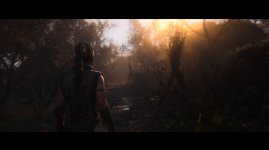


Like with the first game, Ninja Theory kept a cinematic approach to Hellblade II’s presentation. It runs as one long continuous take with virtually no loading screens, akin to God of War, which adds to the intense and intimate experience. This is fuelled by the professional motion capture and voice acting as well as the excellent binaural audio where sound is recorded with two microphones. The effect is best experienced by wearing headphones which mimics a 3D soundscape but also lets players experience Senua’s inner voice resulting from her psychosis. This depiction is made convincing as the game was developed in collaboration with psychology experts as well as people with psychosis to accurately depict the condition. It’s a highly commendable effort to raise awareness of such medical issues through the video game medium.
A fight against tyranny
As with the overall presentation, the gameplay of Hellblade II leans heavily on a cinematic approach as it tells the story of Senua's quest to free her people from the tyranny of their captors. There’s no UI, no on-screen prompt and no traditional tutorial. Some hints are occasionally provided by the voices inside Senua’s head as well as some visual cues that play into the depiction of psychosis. It's a bold, artistic approach that I laud the developers for executing, but it might not sit with everyone. Some might prefer at least some basic tutorial over the controls, especially during combat. Personally, the seamless, cinematic experience that this approach delivered made the game more engrossing.
Such a gameplay design also works as it takes a quasi-walking sim approach. With defined paths, the player is not left wandering aimlessly with no indicators to aid them. Yes, like the first game, Hellblade II has a linear gameplay with minimal interaction. While I would still prefer having some freedom to explore the gorgeous landscapes of the game, the sequel is designed well enough to make me overlook this restriction. Compared to the first game, there is a much better balance between exploration, combat and puzzle-solving sequences. This results in an improved flow, making the gameplay more appealing.
While actions are still limited, there are some open-ended segments, but only to an extent. Some areas allow you to explore and discover potential clues to solve a puzzle and progress further. Puzzles still rely on Senua’s Focus ability, with some requiring Focusing on environmental elements from a particular perspective, while others leading to more significant environmental changes. The puzzle mechanics are simple but figuring out the solutions scales up with difficulty. They are not difficult per se but are rather original and feel satisfying.


As for combat, the mechanics are similar to the first game. Senua can only draw her sword (or attack) when the game enters a combat sequence. She can land light and heavy attacks as well as dodge and parry incoming blows. This time around, there’s a more welcome diversity in enemy types, each with different attack patterns that you need to pay attention to in order to dodge or block before landing a blow of your own. As Senua is practically always outnumbered against waves of enemies, her Focus ability provides her with an edge. Chain enough attacks and you can use Senua's Focus to slow down time and strike enemies quicker and more efficiently. Combats are engaging and offer a fair challenge as you take the driver's seat to fight against tyranny.


With Senua’s Saga: Hellblade II, Ninja Theory has improved on the Hellblade formula to deliver a more balanced, cinematic experience while still pushing the limits of visual fidelity. It is still a linear game with walkin sim vibes but it tells an intense story in a compelling way. Fans of narrative-driven games won’t go amiss with this title and I hope to see more of Senua’s saga in the future.
Senua's Saga: Hellblade II - Official Launch Trailer
Verdict
- Visually impressive
- Engaging plotline
- Binaural audio adds a layer of immersiveness
- More balanced execution than the first game
- Often feels too linear
- Limited player action
- Lack of UI and traditional tutorial can be divisive
