 Anbernic RG 55G1 GBAtemp review
Hardware
Product Information:
- Official Store: https://anbernic.com/en-gb/products/rg-55g1
Anbernic are an enigma. On one hand they produce affordable technology on which to play your games, and on the other they churn out "e-waste" machines that push no boundaries, fit no real purpose and only serve to keep bulking out the roster at Anbernic HQ since they were founded in 2017.
The RG 55G1 is one of the Chinese company's latest Android 14-based machines that sports a horizontal configuration akin to that of Nintendo's highly acclaimed Switch Lite console, but packs in the Snapdragon G1 Gen 2 processor for maximum compatibility at an affordable price. Starting at $139.99 with 4 GB of RAM, 64 GB on-board and no SD card, and climbing to $214.99 with 8 GB of RAM and 128GB+256 GB storage, there are options for everyone to get hold of one of these devices.
The SD card limit on this device is 2 TB, if you want to hold every game ever made in the entirety of history in your pocket.


Multiple Variants, Nice Build Quality
The model I was sent was the black variant with 4 GB of RAM, 64 GB storage on-board and an additional 128 GB SD card. This option will run you $169.99 at retail, though if you have your own SD card knocking about it might be worth opting for the 8 GB version for the additional $35 because the more RAM you have in a device such as this, the more mileage you're likely get out of it.
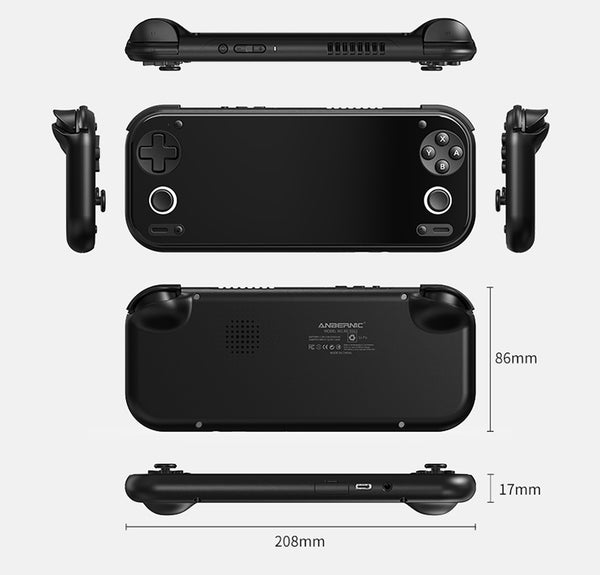
The Anbernic RG 55G1 is an extremely sleek 208 x 86 x 17 mm device. I have to admit that upon opening the box, which has an image of the indigo system, I was surprised to see a gorgeously glossy black version of the handheld in my possession. At just 339 grams it weighs a little more than the device from which it clearly takes inspiration, but it must be said that it feels exceptionally lightweight and during periods of testing, I never once noted any wrist fatigue or hand cramps.
Being a 5.5" 60Hz 16:9 display device, the IPS display is in almost perfect parity with Nintendo's diet-level LCD-based handheld console, but with a notably higher resolution (1080p as opposed to 720p) and the IPS providing great viewing angles with no loss of clarity or colour at almost every angle imaginable. Most of the emulators included output at their native 4:3 ratio, so though 16:9 is nice for running widescreen hacks, you will see some big black borders for the most part.
Brilliant Buttons but Slippery Sticks
Moving around the device, we have the SD card slot, USB-C charging port and 3.5mm headphone jack on the bottom edge. The face of the device has a d-pad, four main face buttons (A, B, X, Y), two back-lit large-angle hall-effect analogue sticks, two forward facing hi-fidelity speakers, and four additional buttons that correspond to various system and in-game shortcuts, such as returning to a menu or scanning your SD card from the games menu. Every button is one-shot moulded and have a brilliantly tactile feel. the main face buttons doesn't feel spongy, yet aren't wholly "clicky" either, but the L and R shoulder buttons, stick buttons, and system buttons are wonderfully clicky and responsive.
The top holds the power, shoulder buttons and hall-effect triggers, two volume buttons (+/-) and a vent for jetting out those thermals. The rear of the device has a fan moulded into it to suck in cool air and pipe it across the SOC through to that vent on the top.
The corners of the device are smooth and fit on your palm perfectly. The sticks and buttons feel nicely placed, but there is one major issue I noted while attempting to use the device in Android mode. The 55G1 is 20.8 CM wide, which means while holding the device at the sides, you need to use your thumbs to type on any keyboards that appear. The main issue being you have to completely adjust your grip to reach the central portion of the screen. It's no deal breaker, but a notably awkward experience nonetheless.
The D-pad and buttons feel great for gaming, with no ghosting or duplicated inputs. The front mounted speakers pump sound out nicely, right into your face, but the rumble that is included is horrible. It's weak and feels poor quality given the otherwise high-quality look and feel of the device.
The sticks are another odd choice. Technically, they're great. The Hall-effect means anti-drift and droop and they're responsive as you could ever want, and smooth too. However, the caps are also smooth, too smooth, with zero grip even when your hands are as dry as a bone. Once slippery, they're like miniature ice rinks. They just needed a texture on top to mitigate this absolute lack of grippiness.


Native for the Majority; PSP and Below Scales well
Emulation is where most people will want to know what this device is capable of. I will state that you can either run your games through the game mode of the RG 55G1, which is effectively a pre-configured build of RetroArch, linked emulators, or you can download your own emulators in android mode and re-link them. The former allows for a lot of tinkering, but you need to know what you're doing. The latter is, in my opinion, the better option, because you can use the latest nightlies, tweaked builds and alternative emulators that bring game-specific configurations.
8, 16 and 32 bit consoles ran perfectly, and PSP, Dreamcast and even GameCube held up really well, but mostly at native resolutions for those higher end machines. Up-scaling too anything intensive is guaranteed to cause dramatic slow-down and as such I would only recommend playing the majority of 6th generation consoles AAA titles at their default settings with some CPU overclock or frame skips to pick up the pace where required.
GameCube ran into issues immediately when launching games via the game menu. I noticed it running the MMJR2 emulator at 28 FPS with unplayable graphic issues with Vulcan, but updating to the latest Dolphin nightly and swapping to OpenGL (press ST at the games screen to alter which emulator it loads with) allowed it to run perfectly natively with around 25-30 FPS on most games I tested. Swapping to 2x resolution absolutely tanked the performance though, dipping to 16 FPS. Scaling is entirely not recommended.
For those wondering, the Hall-effect triggers are NOT analogue triggers, so games that require sliding-scale sensitive triggers for best use (Super Mario Sunshine/Melee/Metroid Prime/Metroid Prime 2, etc), these won't work quite right as you cannot half press them. They will, however, last a long time and never droop!
PS2 is represented here too, but most intensive games run slow, even in the dedicated NetherSX2 Classic app. No combination of native resolutions, back ends and performance tweaks could get every game running well, so definitely stick to less intensive games for this system.
Saturn and DC games ran great with rock solid frame rates in Flycast, Yaba Sanshiro Pro 2, and even the Beetle Saturn core in RA working great. I would recommend turning this off run-ahead on this device full stop. It should eliminate lag on higher end devices by using clever calculations to load a save, predict things, and factor in your input, but the RG 55G1 is categorised as low-to-mid tier thanks to its rather feeble GPU, so features like this only serve to choke the GPU.
PSP in particular runs exquisitely natively, decently at 2x/3x and reasonably at 4x depending on the intensity of the games at hand. God of War Chains of Olympus is an example of a game that requires lower resolutions to run well, but I managed to eke out 2x at 60 FPS without needing frame skips, and 3x ran around the 53 FPS mark with notable sound stuttering.
Even Vita3K runs quite well here for less intensive games, but you absolutely cannot use any up-scaling else it becomes a slideshow.
CEMU is included in the emulator line up, but nothing from the Wii U library runs well. I hate how Anbernic bundles everything and the kitchen sink into every device, only for them to overreach and fall flat. If you read this Anbernic: PLEASE CURATE YOUR EMULATORS.
If you're wondering, no, Switch, PS3 and OG XBOX emulation is not worth attempting here. The GPU is just too weak to handle these with any reasonable results so avoid these at all costs until the emulators mature to run on potato spec machines.
Gen 5 consoles and below, can actually lean into up-scaling, with N64 looking particularly good at 720p, OG PlayStation and Game Boy advance paying exceptionally well and looking great with shaders and up-scaling. Again, here is where the widescreen hacks come into play, with the 5.5" screen looking great with well-made widescreen patches at play.
Dual-screen games run well too. I tested Ocarina of Time on the 3DS via the Citra core and it was very much hit and miss, but using Azahar, it ran brilliantly. Again, the recommended settings are native scaling and with a little clocking if necessary, but overall it was a very playable experience, albeit in landscape mode because in the portrait orientation, to fit the screens evenly, the buttons are extremely awkward to attempt to use. Perhaps with some kind of grip and a Bluetooth controller you could use this in "TATE-mode" but honestly it's probably not worth it, but in landscape mode the second screen is minuscule if you scale the main screen to fit the height of the screen.


Classy CPU but, no GPU Grunt
The Geekbench scores here don't really indicate much here. The hardware configuration is relatively low end, but the maturity of the emulators make up for the lack of power by working better than they reasonably should in some cases.
Would the 8 GB RAM version make much difference for emulation? I'm not sure. It should make a difference for Android gaming, as long as the games are compatible with the CPU and GPU configuration, and it will allow for quicker multitasking and holding apps in the background, but is it worth the $35 extra? Possibly for Android and PC gaming/streaming via game native, but not for emulation.
Overall we have to consider that while the Snapdragon G1 Gen 2 CPU is relatively decent, the Adreno A12 GPU is extremely underpowered for the task it is being applied to. It is, at best, a low tier GPU, so no wonder overclocking is required to gain some extra grunt, however, I would always state that with most of these handhelds (unless its a beastly wolf in sheep's clothing) you should typically aim for native resolutions in 3D games, no up-scaling or GPU-intensive shaders, and no texture packs or anything that could chip into the overheads you have and any resolution boosts you get should be considered a bonus.
Available in retro grey and indigo too, the Anbernic RG 55G1 is a device that could be better, possibly should be better, but is very serviceable for handheld enthusiasts. The design is on point and it's comfortable for long periods of use, but it's woefully underpowered for those wanting to go big and use the latest greatest GPU-intensive emulators for the most recent generations.
Verdict
- Runs most retro emulators well; depending on app/core maturity.
- 8-hr battery under load, 12-hrs maximum.
- Sleek clean design and hard-shell case included.
- Adreno A12 is weak.
- Struggles with a few systems.
- Horrible rumble.
- Slippery stick tops.
- Perhaps a bit expensive vs. performance.