SuperChis Prime: How I Fixed the SuperCard SD's Flaws on a Budget

Hello players, I'm one of the designers behind the SuperChis project. I’d like to share, from an engineer’s perspective, the thinking and execution behind our new GBA flash cartridge, the SuperChis Prime.

Our goal was clear: to create a genuinely "good" budget cartridge within a $15~$25(depends on tax and shipping) price range by solving the core issues that plague the classic SuperCard SD.
This wasn't just about patching an old design; It's a reconfiguration for a better future.
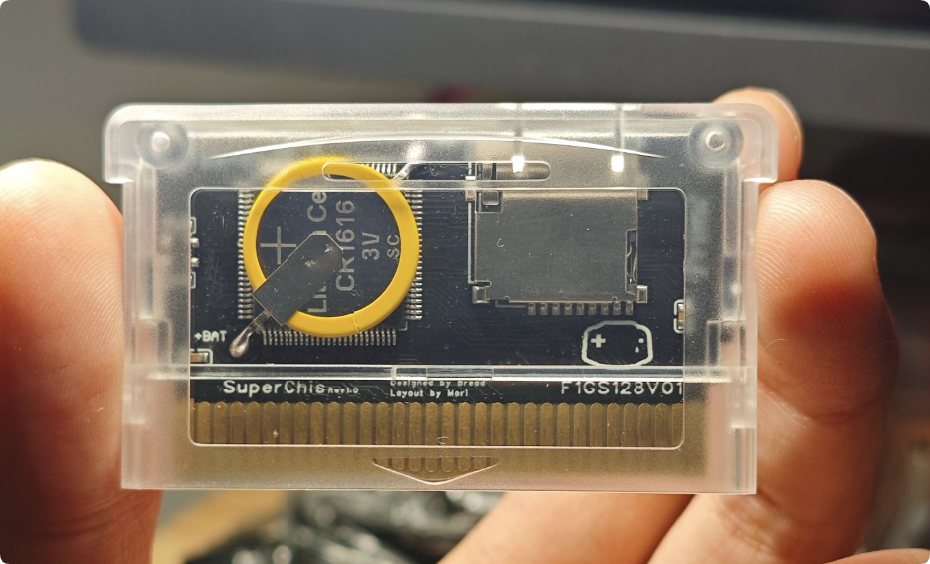
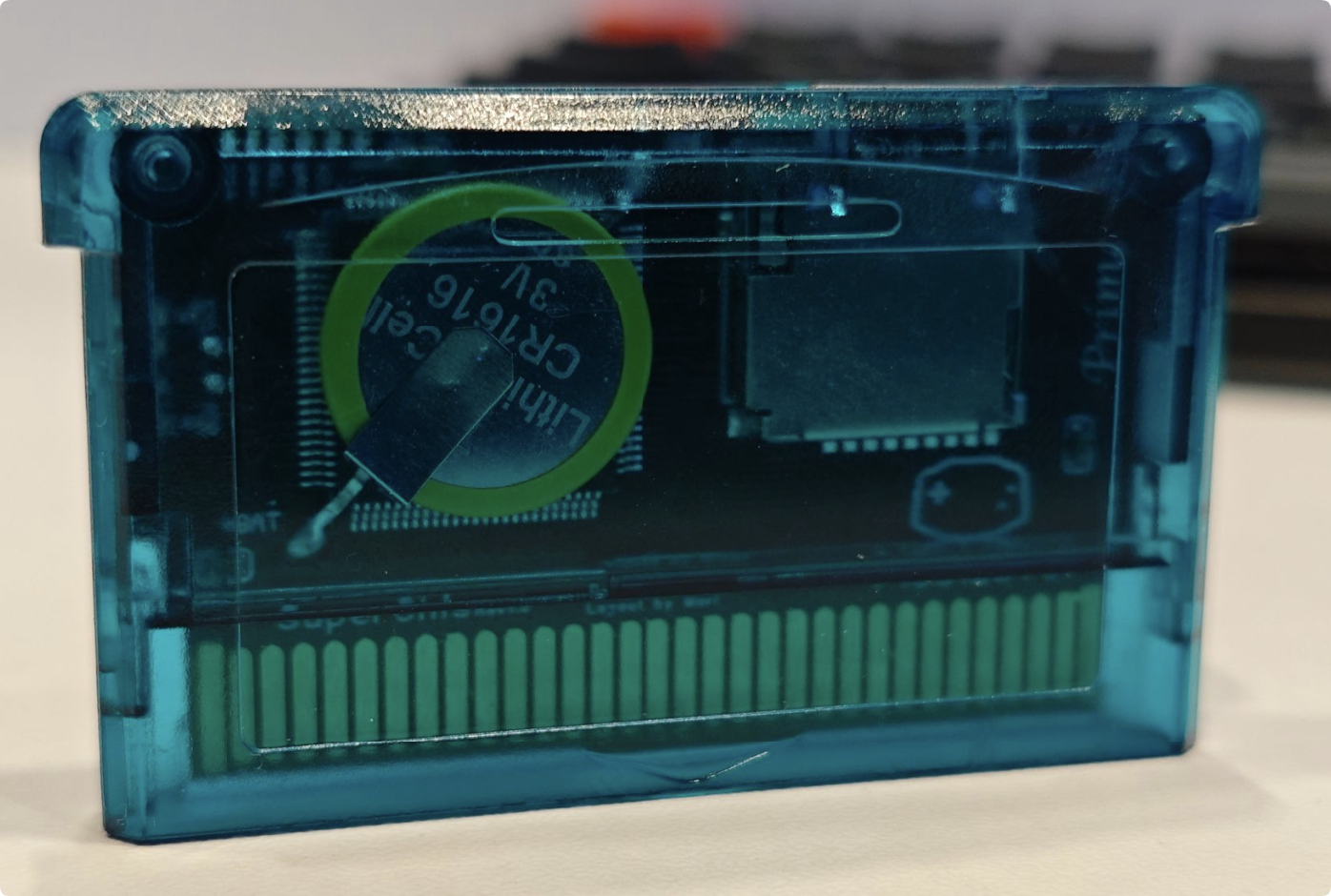
1768192599542.png
1768192570785.png

1. Hardware: Targeted Solutions​

The root causes of the classic SuperCard's problems—"slowdown" and "white screens"—lie in its SDRAM timing compatibility and the need for "slowdown patches" for every game. Our approach was twofold:

  1. Using Large NOR Flash to Bypass SDRAM Issues: I replaced the NOR Flash with a larger-capacity chip. When a game is written to the Flash, the GBA CPU reads directly from it, completely bypassing the problematic SDRAM access timings. This eliminates "slowdown" and the "white screen/freeze" caused by failed patches at a fundamental level. We also deeply optimized the write speed. Burning a 32MB game takes about 105 seconds on the standard version, and only about 85 seconds on the "Micron" version with higher-performance Flash.
  2. Premium PCB Process: To ensure long-term reliability, especially for the contact fingers, we use a 2U Immersion Gold (ENIG) process for our PCB manufacturing. It's an invisible upgrade, but we believe it's essential.
  3. Standardized and elegant PCB layout: It can improve product stability and avoid some anomalies that are not caused by component quality. Thanks to Mori, for his perfectionism.

2. CPLD Firemware: A Clean-Slate Approach for a Better Future​

The original SuperCard's CPLD firmware was "black box". So, we made a decision: we started from scratch with a completely new, forward-designed firmware. Thanks to davidgf for the many suggestions, which have benefited me a lot.

  • More Developer-Friendly: The new firmware has clear logic, avoiding potential register conflicts and other hidden issues. This provides a much better foundation for long-term support and feature development for excellent third-party kernels like SuperFW.
  • Multiple compatibility interfaces: We are compatible with SuperCard SD's SD Write/Read, and also support SuperCard Lite's SD Read. This helps to quickly migrate existing excellent software.

3. "Hybrid Architecture" and Fragmented Flash Management​

Making a simple NOR Flash cart isn't hard. The challenge was balancing flexibility and features at a low cost.

  • Fragmented Flash Management: Users don't need to worry about a game's physical location on the Flash. You can add or delete games as easily as managing files on your phone, and the system handles the space allocation automatically.
  • Retaining SDRAM for Unique Value: We didn't discard the SDRAM just because we added Flash. We repurposed the SDRAM as a "preview/launch area" and, crucially, as the memory for some feature. This "Flash + SDRAM" hybrid architecture allows us, at a low cost, to offer both "instant game launch with no slowdown" (from Flash) and "advanced features like Instant Saves" (from SDRAM).

4. GBA Firmware​

At present, SuperFW has fully supported SuperChis and may be released in next version. Because SuperChis are forward compatible, there will be more custom firmware support in the future. It's worth noting that the time to enter the SuperFW was reduced from 6 seconds to 1 second because we had a larger Flash and avoided asset decompression. davidgf's rotating meta data design largely avoids uneven flash writes.

5. The Necessary Trade-Offs​

Within our strict cost targets, we had to make some compromises:

  1. No RTC/Rumble/... Support: This was to control core chip complexity and cost. The software clock in the SuperFW kernel keeps time while in-game.
  2. Standard Battery-Backed Save: The standard version uses a CR1616 battery with low-power SRAM, offering a theoretical save retention of up to 20+ years (conservatively estimated at 10). We solved the problem of SuperCard batteries dying prematurely by using low-power SRAM and designing strictly according to the manual.
  3. Compatibility issues: We have found that the some GBAs on the motherboards labeled 02 have power supply issues, and cannot use the common NOR Flash, and need to use the more expensive low-power, high-performance NOR Flash, for which I have already funded research, and hope that the 02 motherboards can be resolved in the future with a simple mod. Or you can replace it yourself with a more expensive flash like the MT28.
  4. Save Game Handling: Support for games with EEPROM/Flash saves relies on the SuperFW database and patching engine. While this covers virtually all commercial games, some homebrew titles (e.g., certain Pokémon ROM hacks) may require manual intervention.
  5. Use recycled ICs: Whether it is mass production or DIY, for GBA game scenarios I recommend using tested recycled ICs. Especially for those NOR Flash that still have more than half of their life left. This is more economical and environmentally friendly. Of course, the test process includes full erasure, writing, stress testing, etc. Of course, you can also replace it with a new NOR Flash by yourself, which will cost $20~$30. As long as the speed is faster than S29GL01GS12, it will be a good Flash choice.

6. Acknowledgments and Planning​

Thanks to Mori, and Davidgf for supporting this project. More versions of the SuperChis series will be released in the future, and the core ideas will be open-sourced to encourage more interesting innovations. The CPLD implementation of the original SuperCard can be found at SuperChis.
 
Yeah.
We have 992Mbit of NOR space. About 5 to 10 games.
There is no B mode.
Post automatically merged:

Hello!
We found the problem with the 02 motherboard. The reason is that the power supply is insufficient and the common S29GL01GS cannot be used. JS28F00AM29EWH needs to be used, at the cost of longer flashing time (about double)
Or you can add a capacitor to the 02 motherboard, or replace it with a better inductor, or replace the power IC.

Considering that the flashing speed greatly affects the experience, I will not take the initiative to mass-produce the JS28 version, but just let everyone know why.
Could you document in more detail what to modify? I’d like to buy several of these carts for my kids Gameboy Advances but one of them is the 02 model.

I’ve done other upgrades on them and have no issues swapping out some components on the motherboard. Is there a specific better inductor to purchase? That seems easy to desolder and swap without too much hassle.
 
Could you document in more detail what to modify? I’d like to buy several of these carts for my kids Gameboy Advances but one of them is the 02 model.

I’ve done other upgrades on them and have no issues swapping out some components on the motherboard. Is there a specific better inductor to purchase? That seems easy to desolder and swap without too much hassle.

I will, we're doing more testing to make sure we can actually fix the problem. At present, we have solved the problem of failure in the flash process, but there are still some instability issues in the game.

The good news is that I found some NOR Flash, they are slower but low power consumption and can be used with these GBAs. Maybe I should produce a batch of these SuperChis?
 
are there any sellers that ship to germany from aliexpress? the one link (chisfamily) posted here is dead/not shipping to germany.
 
Packaging feels very premium for such an inexpensive product. Included USB 2.0 SD cart reader is a nice touch as well :) So far it seems to do everything as advertised :) First I experienced a bit of a slowdown in Mario Kart but after switching to flash it went away. Loading saves state is crashing the game for me but I do understand it is extremely difficult if not impossible feature to implement to work flawlessly. I will compare with EZ Flash ODE once it arrives (if it arrives).
Post automatically merged:

It's strange because superfw GitHub says SuperChis support was added in 0.19, it shipped with 0.18 firmware though. I updated to 0.19 anyway. No issues so far.
 
Last edited by astrojs,
I saw a listing on AliExpress that shows multiple cart labels of different colours, I don't think the official store listing shows them. Are these supplied, in either case?
Post automatically merged:

Also just seen this other listing from yet another store, that offers an FRAM option... Anyone know if they're legit?

https://a.aliexpress.com/_EIQV4gc

Edit: the one linked is a brand new store (16th Jan) with no reviews
 
Last edited by hippy dave,
I saw a listing on AliExpress that shows multiple cart labels of different colours, I don't think the official store listing shows them. Are these supplied, in either case?
Post automatically merged:

Also just seen this other listing from yet another store, that offers an FRAM option... Anyone know if they're legit?

https://a.aliexpress.com/_EIQV4gc

Edit: the one linked is a brand new store (16th Jan) with no reviews
The ChisFamily listing does come with multiple labels. Also, that FRAM version is pretty cool because I believe it removes the need for a battery in the cart whatsoever. It's only used for SRAM save backup if I understand correctly. But it is kinda steep for this cart at $41. The ChisFamily version with SRAM is almost half that price.
 
  • Like
Reactions: hippy dave
The ChisFamily listing does come with multiple labels. Also, that FRAM version is pretty cool because I believe it removes the need for a battery in the cart whatsoever. It's only used for SRAM save backup if I understand correctly. But it is kinda steep for this cart at $41. The ChisFamily version with SRAM is almost half that price.
Thanks for the info about the labels. I'd want the green one 💚

Maybe you looked at the price of the FRAM cart with a supplied micro SD card? The cart on its own shows at about 23 quid for me, which Google says is closer to 31 dollah.
 
Thanks for the info about the labels. I'd want the green one 💚

Maybe you looked at the price of the FRAM cart with a supplied micro SD card? The cart on its own shows at about 23 quid for me, which Google says is closer to 31 dollah.
Nope. The FRAM version with no SD is listed at $41.
IMG_20260201_083206.jpg
The ChisFamily listing with SRAM is $23.
 
Yikes. Tariffs or some shit?

View attachment 554253
I wouldn't think so. They just listed it that high. The ChisFamily listing ships from China to the US and that's $23. Granted that one uses SRAM. I can't imagine the FRAM doubles the price. Especially considering the price difference isn't as dramatic where you live.
 
Also, that FRAM version is pretty cool because I believe it removes the need for a battery in the cart whatsoever.

That FRAM version is really interesting. Although not an essental upgrade in my opinion, since the battery should last a respectable amount of time. Does anyone have any estimates for the battery lifetime?

I've been testing more in my 02 AGB-001 model, so far it's working great!. The savestate functionality is really useful for some games, although a bit glitchy depending on the game, sometimes it helps to load the savestate on the same stage/level where it was made.

Just two minor issues. There was at least one time where the game from flash took a really long time to load (like 15 seconds or more), that may be related to the power issues in 02 models but flashing never failed me (it does make some funky noises when flashing though).

Another minor issue, I found the direct saving option to be really finicky, it seems to be supported only on a few games (the UI does state this fact), I don't remember if this was also the case for the original Supercard, the safest option is to choose SRAM saving on reset for all games unless you want to experiment, maybe a database of compatible games could be made in the future.

On a personal note, this has become my favourite GBA flashcart. It really is the perfect balance between price and performance the GBA market was missing for so many years. I'm actually using it more than the Ez-Flash Omega since it doesn't have the save corruption issue due to slow SD transfer speed, the Omega may still have better RTC implementation though.

Finally, I want to remind everyone there is an updated version of SuperFW that supports the Superchis. My cart was flashed with version 0.18 (1a965b88) and I assume all carts will have the same version which is outdated as I'm writing this.
 
  • Like
Reactions: hippy dave
That FRAM version is really interesting. Although not an essental upgrade in my opinion, since the battery should last a respectable amount of time. Does anyone have any estimates for the battery lifetime?

I've been testing more in my 02 AGB-001 model, so far it's working great!. The savestate functionality is really useful for some games, although a bit glitchy depending on the game, sometimes it helps to load the savestate on the same stage/level where it was made.

Just two minor issues. There was at least one time where the game from flash took a really long time to load (like 15 seconds or more), that may be related to the power issues in 02 models but flashing never failed me (it does make some funky noises when flashing though).

Another minor issue, I found the direct saving option to be really finicky, it seems to be supported only on a few games (the UI does state this fact), I don't remember if this was also the case for the original Supercard, the safest option is to choose SRAM saving on reset for all games unless you want to experiment, maybe a database of compatible games could be made in the future.

On a personal note, this has become my favourite GBA flashcart. It really is the perfect balance between price and performance the GBA market was missing for so many years. I'm actually using it more than the Ez-Flash Omega since it doesn't have the save corruption issue due to slow SD transfer speed, the Omega may still have better RTC implementation though.

Finally, I want to remind everyone there is an updated version of SuperFW that supports the Superchis. My cart was flashed with version 0.18 (1a965b88) and I assume all carts will have the same version which is outdated as I'm writing this.

Thank you very much for your review!

I also recommend turning off DirectSaving unless the battery is dead. The SuperChis sold on AliExpress use my compiled SuperFW, which was compiled before version 0.19 and has not been updated. This will cause some trouble, and I will solve this problem in the next batch of production.
 
  • Like
Reactions: cearp and JORGETECH
Thank you very much for your review!

I also recommend turning off DirectSaving unless the battery is dead. The SuperChis sold on AliExpress use my compiled SuperFW, which was compiled before version 0.19 and has not been updated. This will cause some trouble, and I will solve this problem in the next batch of production.

It's not a major issue (if it's one at all) since it's expected the user will eventually flash a newer version in this kind of product.

For anyone upgrading, keep in mind the latest version needs to be flashed like if it was the first time flashing SuperFW (from the DS flasher or bootstrapping the SuperFW gba file), everything is explained in the SuperFW GitHub, but I've seen some confused users that upgraded to the newer version without reading the release notes.
 
It's not a major issue (if it's one at all) since it's expected the user will eventually flash a newer version in this kind of product.

For anyone upgrading, keep in mind the latest version needs to be flashed like if it was the first time flashing SuperFW (from the DS flasher or bootstrapping the SuperFW gba file), everything is explained in the SuperFW GitHub, but I've seen some confused users that upgraded to the newer version without reading the release notes.

I have some data about battery life, but there is no conclusion yet. We can collect feedback in ten years, hahaha.

After testing, the current of SRAM in sleep mode is 70 ~ 100nA, which means almost no loss, we only need to consider the self-discharge of the battery.
 
I have some data about battery life, but there is no conclusion yet. We can collect feedback in ten years, hahaha.

After testing, the current of SRAM in sleep mode is 70 ~ 100nA, which means almost no loss, we only need to consider the self-discharge of the battery.
The self discharge is between 1 and 3% per year, so, if the shipped battery is brand new, it will require a long time for us to have a dead battery...
 

Site & Scene News

Popular threads in this forum